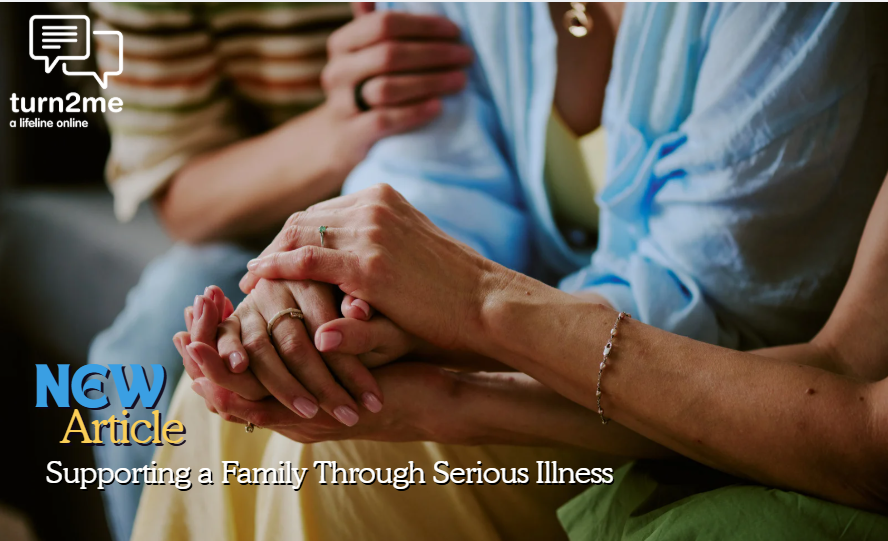
In my work as a Psychotherapist and Clinical Manager at Turn2Me, I often speak about the
emotional weight of life transitions: the uncertainty, the changing roles, and the grief that can begin
long before a death. I understand these experiences professionally. These days, I also understand
them as a daughter and a sister, with a very ill father and a family learning, sometimes gracefully,
sometimes not, to live around that reality.
There is a particular vulnerability in knowing the language of grief while still being unable to protect
the people you love from it. Clinical knowledge helps me recognise what is happening, but it does
not grant me immunity, or a clipboard sturdy enough to organise everyone’s feelings. At times, I am
the person who can name the experience, at others, I am simply a daughter worried about her
father and a sister trying to stay connected while each of us copes in our own, occasionally
exasperating, way.
When Roles Begin to Change
Serious illness can change family roles gradually and then, somehow, all at once. An independent
parent may need practical help. Adult children become advocates, organisers, carers and unofficial
managers of medication lists, appointment times and the family group chat, the place where one
sibling asks a sensible question, another replies three hours later with a thumbs-up, and somebody
else starts a completely separate debate about who has the spare key. Behind the banter, of course,
is a family trying to manage fear while still functioning.
Few people can drive us nuts quite as efficiently as a sibling. They know the history, the weak spots
and exactly how to make one innocent sentence sound like a continuation of an argument from
1997. Yet they may also be the only people who fully understand the family shorthand, the stories
and the particular kind of love involved. One person needs information and action; another goes
quiet; someone else makes tea, cracks a joke or insists they already told everyone the consultant’s
update. Different responses do not mean different levels of care. Support is not about getting
everyone to cope in the same way. It is about allowing for those differences, choosing our battles
and keeping communication clear, kind and, where possible, lightly seasoned with humour.
Understanding Anticipatory Grief
Anticipatory grief is the grief we may experience when we know that a significant loss is
approaching. It can include sadness, anxiety, anger, guilt, numbness and even moments of relief
when a period of uncertainty briefly eases. These feelings may come and go. A good day can bring
hope; a difficult appointment can make the future feel suddenly close.
For me, anticipatory grief often turns up in ordinary moments: noticing something I want to tell my
father, thinking ahead to a family occasion, or watching my own child with their grandfather. The
mind has an exhausting habit of racing ahead, rehearsing futures nobody asked it to rehearse.
When that happens, I try to return to what is true today, what can be said, shared, laughed about or
simply witnessed now. Turn2Me’s private Thought Catcher can help with this: putting a feeling into
words, even briefly, can create a little space between the emotion and the rest of the day.
Caring for Yourself While Caring for Others
Self-care can sound suspiciously like another item for the to-do list when appointments, work and
family responsibilities carry on regardless of how overwhelmed we feel. It does not have to involve
candles, perfect morning routines or pretending a cup of tea can fix everything, although tea has
made a respectable attempt in many a household. It may simply mean eating regularly, taking a
short walk, jumping into the cold sea, accepting practical help, protecting sleep where possible, or
speaking honestly with one trusted person. Turn2Me’s online supports can fit around a life that
does not pause for grief: a person living in Ireland can apply for up to six free consecutive one-to-one
counselling sessions and join from a phone, tablet or computer. Sometimes practical accessibility is
what makes asking for help possible.
Limits matter too. Being a loving daughter, son, sibling, partner or parent does not require being
available every minute or answering every family message within thirty seconds, especially when
half the messages are variations of “Who is going up today?” Practical conversations can help, what
needs doing, who can realistically do it, and where outside support is needed. If tensions rise, as
they most likely will, returning to the shared concern, the wellbeing and dignity of the person who is
ill, can help everyone step out of the family drama and back onto the same side.
After a Loss
After a death, grief rarely follows a neat sequence or timetable. It does not consult the calendar,
respect a busy week or wait until we have finished the school run. There may be shock, exhaustion,
yearning, anger, relief, confusion, or stretches of feeling almost normal. Then a song, a familiar
phrase or an ordinary trip to the supermarket can bring it rushing back. None of this means a person
is grieving incorrectly. Grief is not a problem to solve; it is a human response to attachment and
loss.
For those also raising a young family, grief can feel especially complicated. Children still need
breakfast, reassurance, school runs and help locating the shoe that was definitely there five minutes
ago, while the grieving adult may feel completely depleted. Age-appropriate honesty is usually more
helpful than trying to hide every emotion, which is just not possible. Children can learn that sadness
is safe, memories can be shared, laughter is not disloyal, and family life can hold grief and joy at the
same time.
Reaching for Support
Support may come from family, friends, a GP, a counsellor, a bereavement service, a faith or
community network, or a trusted workplace contact. Turn2Me offers qualified online one-to-one
counselling, as well as free anonymous support groups facilitated by mental health professionals.
The groups use instant chat rather than cameras, which can feel like a gentler first step: you can
share, listen and learn practical coping strategies without having to present a “polished” version of
yourself, aka you can attend while in your PJ’s. There are groups on grief and other life challenges
throughout the week; the current timetable is available through Turn2Me.ie. Professional support
may be particularly helpful when distress feels unrelenting, daily functioning is significantly affected,
or someone feels unable to cope safely. In an immediate crisis, contact emergency services or an
urgent crisis support service.
As a psychotherapist and clinical manager, I know the value of reaching out early rather than waiting until everything feels unbearable. As a daughter and sister, I also know that asking for help can be difficult. Sometimes the most honest first sentence is simply, “I am finding this harder than I expected.” That is enough to begin.
Holding On to What Matters
Living alongside serious illness teaches us that strength is not the absence of fear, sadness or the
occasional family disagreement over something spectacularly unimportant. It is the willingness to
stay present, have difficult conversations, repair misunderstandings and accept that love cannot
control every outcome. My professional experience gives me frameworks for understanding this
time; my family keeps reminding me that real life rarely fits neatly inside one.
For anyone walking a similar path, please remember, grief is messy and unpredictable, it is not
possible to hold the whole family together alone, or know what comes next. Some days will be
tender; some will be chaotic; some will contain both tears and an argument about who said they
would bring the milk. Attend to today. Let others help. Say what matters while there is time. Laugh
when laughter comes. And offer yourself the same compassion you would give someone you love.
Turn2Me is available when talking to the family feels unhelpful, and it is exactly what has worn you
out. Anyone living in Ireland can apply for up to six free consecutive online counselling sessions.
Turn2Me also provides anonymous, professionally facilitated online support groups, including grief
support, alongside the private Thought Catcher mood diary and a library of articles and podcasts.
Turn2Me a lifeline, online.