For many men, distress does not announce itself as sadness. It can look like working longer
hours, drinking more, withdrawing from friends, snapping at loved ones, lying awake at night,
or saying “I’m grand” when everything feels anything but. Mental health challenges do not
discriminate by gender, but the way men experience, express and seek help for them often
follows a very different path.
As a psychotherapist and clinical manager at Turn2Me, I have seen how powerful cultural
expectations can be. I have also seen what changes when men are offered support that
feels private, practical and accessible. Online therapy is not a magic solution, but for many
men it can be the first step towards speaking honestly, safely and without judgement.
Why Men Often Wait Too Long to Seek Support
In clinical practice, certain patterns appear again and again. They are not signs that men do
not care about their mental health. More often, they show how deeply many men have
learned to hide, minimise or rationalise their pain.
Late presentation is the norm, not the exception.
Men frequently arrive at therapy only after reaching crisis point, a relationship breakdown, job loss, a health scare, or the moment when “coping” simply stops working. The idea of seeking support before things collapse can feel unfamiliar, even indulgent, to many. Irish and UK research tells the same story: men are less likely to access counselling or mental health support, even though the need is clear. The HSE notes that men are less likely to go to counselling and more likely to find it difficult to talk about emotional challenges with friends or family.
Symptoms present differently.
Where women might articulate sadness or anxiety, men often express distress through irritability, anger, withdrawal, risk-taking, alcohol or substance use, overworking, or physical complaints such as headaches, stomach problems or exhaustion. This means men may not recognise their own struggles as mental health issues at all. A man may say he is “stressed”, “wrecked”, “snapping at everyone” or “not himself”,
long before he says he is anxious, depressed or lonely.
The language of emotion feels unfamiliar.
Many men I work with lack a vocabulary for their inner lives, not because they’re incapable of depth, but because they’ve never been taught or encouraged to develop one. Therapy becomes, in part, a process of learning to name what they feel.
The Irish and UK picture is stark.
In Ireland, around 8 in 10 people who die by suicide are men, according to the HSE. Samaritans’ analysis of Irish data reported 500 deaths by suicide in 2022, with the highest number occurring among people aged 40 to 44. In England and Wales, the Office for National Statistics reported 6,190 suicides registered in 2024, with
a male suicide rate of 17.6 deaths per 100,000 compared with 5.7 for females. These figures
are not abstract. They represent fathers, sons, brothers, partners, colleagues and friends
whose pain may have been hidden in plain sight.
The Cultural Messages Men Carry
The barriers men face are not personal failings. They are often the result of messages
absorbed from childhood and reinforced in families, schools, workplaces, sport, media and
friendship groups.
“Be strong. Don’t complain. Handle it yourself.” These messages are absorbed early
and reinforced constantly. Traditional ideas of masculinity can frame emotional expression
as weakness and self-reliance as the ultimate virtue. The result is that men may learn to
suppress rather than process, and to soldier on rather than seek support.
Help-seeking as failure. Asking for help, whether from a friend, partner, or professional, can
feel like an admission of inadequacy. In male-dominated environments especially,
vulnerability is risky. Men report heightened stigma in workplaces like construction,
emergency services, and the military, where “toughness” is currency.
The provider identity. Many men define themselves primarily through what they do for
others, earning, protecting, fixing. When distress interferes with that role, shame compounds
the original problem. Admitting struggle feels like failing at the core of who they are.
These messages are not merely inconvenient. They can be deadly. The HSE states that 8 in
10 people who die by suicide in Ireland are men. In England, Samaritans reported that three
in four suicides registered in 2024 were men, with middle-aged men continuing to have the
highest suicide rate of any group. The silence is not stoicism. It is a public health crisis, and
it is affecting families and communities across Ireland and the UK.
Why Online Therapy Can Make the First Step Easier
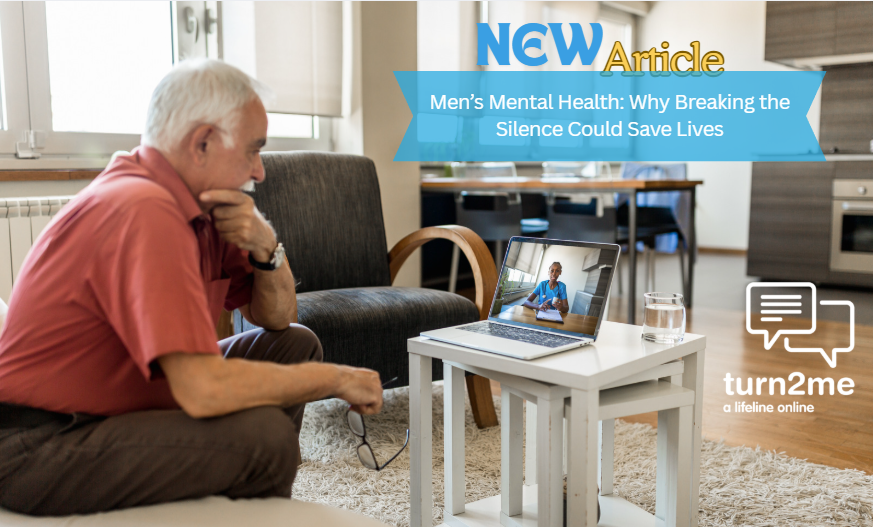
This is where digital support can make a real difference. In my role at Turn2Me, I have seen
how online platforms can lower the threshold for men who might never walk into a private
practice, but who may be willing to log in from somewhere they feel safe.
Turn2Me’s online model matters in this context because it meets people where they are. For
Irish residents, Turn2Me offers free online counselling sessions, anonymous peer support,
support groups and practical tools such as the Thought Catcher mood diary. For someone
who has spent years keeping things contained, the ability to begin privately, from home, and
at their own pace can make support feel possible for the first time.
Privacy and control. Online therapy removes the fear of being seen entering a therapist’s
office. For men in small communities or high-profile roles, this discretion matters enormously.
Sessions can happen from a car, a home office, or anywhere that feels private.
Reduced performance pressure. The physical distance of a screen can paradoxically
create emotional closeness. Some men find it easier to be vulnerable when they’re not
sitting directly across from someone. The format feels less exposing.
Flexible scheduling. Structural barriers, work hours, family responsibilities, geographic
isolation, disproportionately affect men’s access to care. Online therapy fits around life rather
than demanding life reshape around it. For shift workers, remote employees, or fathers
juggling childcare, this flexibility can be the difference between engaging and not.
A first step that doesn’t feel final. Digital platforms offer a lower-commitment entry point. A
man unsure about therapy can try a session without the weight of an ongoing in-person
relationship. If it doesn’t work, he can step back. This reduces the stakes of getting started.
What Helps Men Engage With Therapy
There is no single way to support men’s mental health, but some approaches consistently
make therapy feel more relevant, respectful and useful.
Reframing help-seeking as strength. The courage required to examine one’s own pain, to
sit with discomfort rather than numb it, this is harder than ignoring it. Framing therapy as
problem-solving, skill-building, or resilience training aligns with values many men already
hold.
Peer connection. Men respond powerfully to hearing other men’s stories. Peer support,
whether formal groups or informal conversation, normalises struggle and reduces isolation.
Knowing they’re not alone shifts something fundamental.
Practical, goal-oriented work. While insight matters, many men engage more readily with
tangible strategies. Such as stress management techniques, communication skills, sleep hygiene.
Progress they can measure keeps them coming back.
Building emotional vocabulary. Sometimes the most valuable work is simply teaching
clients to identify what they feel. This isn’t remedial, it’s foundational. Naming an emotion is
the first step to managing it.
Changing the Conversation
Breaking the silence around men’s mental health requires change at every level: individual,
relational, cultural and structural. It also requires us to make support feel more like a normal part of looking after ourselves.
For clinicians, it means adapting our language and approach, meeting men where they are
rather than expecting them to arrive already fluent in therapeutic norms. Organisations, it
means creating workplaces where vulnerability isn’t penalised and mental health resources
are genuinely accessible. For all of us, it means examining the messages we send to the
boys and men in our lives about what strength really looks like.
The goal isn’t to make men more like the existing model of the “ideal therapy client.” It’s to
expand our understanding of what care can look like, and to make clear that seeking support
isn’t a departure from masculinity, but an expression of it.
Silence has not protected men. If anything in this article feels familiar, the irritability, the
exhaustion, the shutting down, the pressure to keep going, or the belief that you should be
able to handle everything alone, please do not wait for a crisis to prove you deserve support.
Turn2Me offers a safe, confidential online space where you can talk, reflect and take the
next step at your own pace. Visit turn2me.ie today and start the conversation. You do not
have to do this alone.
Turn2Me.ie A Lifeline Online!